
Acacia
Acacia is a tree with roughly 1300 species around the world and is easily recognised by its umbrella shaped canopy. The scientific name for the species of Acacia T&G use is ""Samanea Saman Merr"" often known as the Rain Tree and in US and European circles as ""Monkey Pod"" . It is well appreciated with environmentalists because of the enormous amount of CO2 this tree can absorb - very useful when planted along roadsides.
This species, popular for its timber, can be found over much of South East Asia. It grows at a fast rate (0.75 to 1.5m annually)and it is also interplanted as a shade tree with other crops such as coffee or cocoa.
In Thailand, it is cultivated in many areas, especially the North, East and Centre much planting is along roadsides for producing shade.
It can grow to around 25m high and the canopy will be wider than the height but in the last 15-20 years Acacia trees have been cut leaving the root so that the tree sprouts again as with our native Willow which we call ""Pollarding"" and T&G assume that is why this timber is also called ""Black Wattle"".
In some areas of Thailand villagers still plant new Acacia trees as they are popular hosts to an insect called ""Laccifer Lacca Kerr"". This insect produces a scarlet, resinous secretion often used as food colouring and is similar to our ""Cochineal"". It is also applied to dyes and lacquers as a colourant and is often referred to as ""Shellac"".
There is also a certain amount of self-seeding but in certain provinces villagers are encouraged to plant Acacia trees from seeds supplied by officers of the Royal Forest Department of Thailand to increase the local resource.
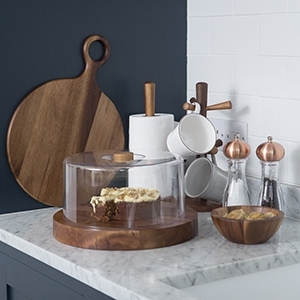
The timber has been referred to as ""Black Wattle"" or from its appearance ""Black Walnut"". T&G consider Acacia a rich coloured wood with a wild grain. Very hard and most suitable for use in the home from cutting boards to chairs.
Care Instructions: All T&G Acacia products have been sealed with a non-toxic protective lacquer and are oiled to enhance the appearance and to help prevent the absorption of water when washed. Hand wash in warm water with mild detergent, do not soak, dry immediately. Not dishwasher safe.
As with all Woodware, acacia can dry out with use, so an occasional wipe with T&G’s food safe wood oil does much to restore the original natural appearance. Download our Which Wood Guide
